
Every month, a client forwards me a LinkedIn post claiming search is finished, and their website is about to become an expensive brochure. I understand why the panic spreads. The people shouting loudest usually have a monitoring tool or a fresh acronym to sell.
New survey work out of the UK gives us data. YouGov asked 2,003 British adults where they actually start when they look something up, and the answer is different from what the doom posts predict.
I read the whole thing through the eyes of an owner deciding where next quarter’s money goes. Below is my translation: what the numbers say, what I’d ignore, and the three moves worth making now.
Key Takeaways
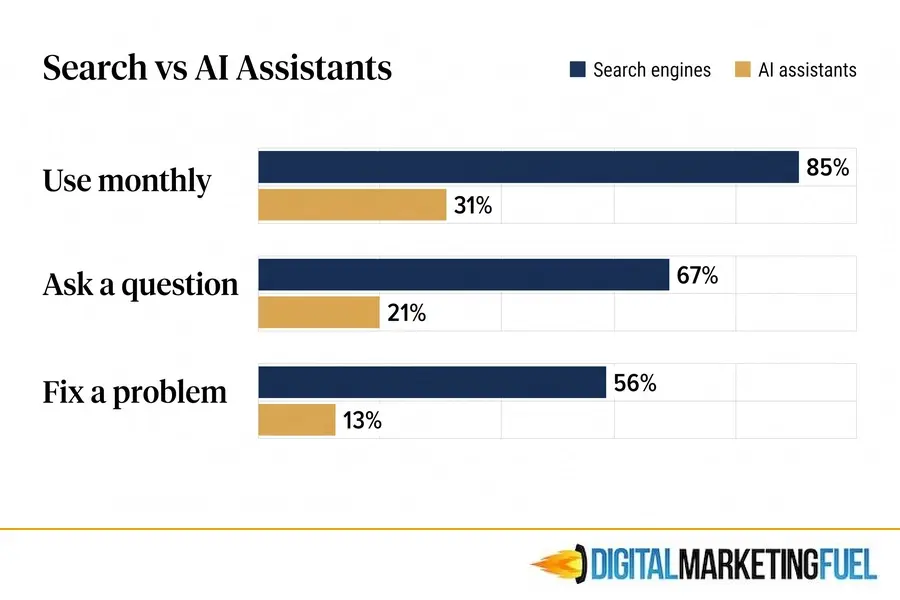
- Search engines were used by 85% of online searchers in the past month. AI assistants: 31%.
- People start at Google for questions, product research, and buying. AI shows up mostly as a second opinion.
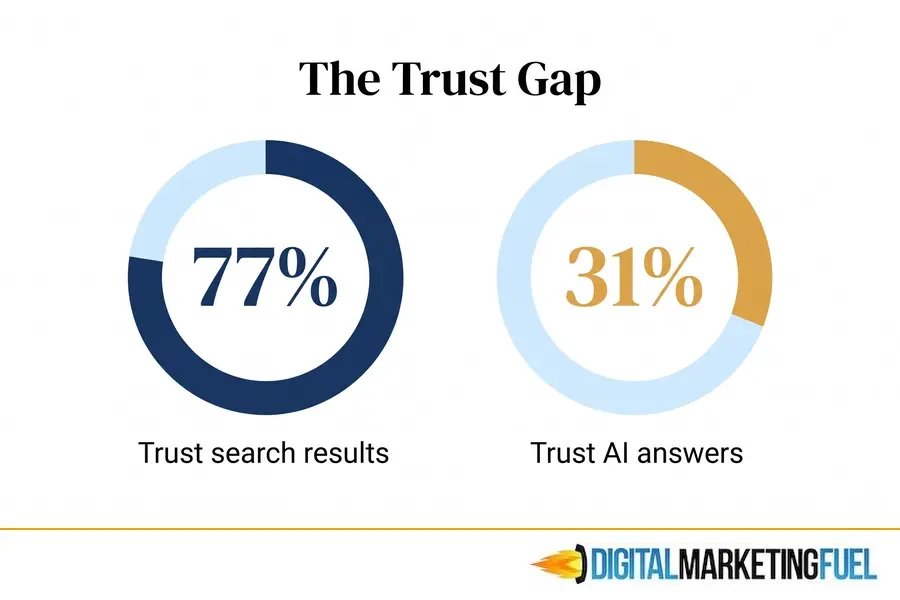
- Trust is the gap that matters. 77% trust search results at least somewhat, versus 31% for AI answers.
- Getting mentioned inside an AI answer isn’t the same as getting a customer.
- The fixes that improve AI visibility are the ones you were already supposed to be doing.
The AI Usage Numbers
The survey ran online between April 21 and May 29, 2026, and it covers Great Britain, so treat the exact percentages as directional for a US company. Direction is still useful. Here’s where people said they begin, by task:
| Task | Start at a search engine | Start with an AI assistant |
|---|---|---|
| Asking a specific question | 67% | 21% |
| Researching products | 64% | Lower, no clear lead |
| Buying products | 60% | Lower, no clear lead |
| Fixing a problem | 56% | 13% |
Maps and news sites each pulled 39% of monthly use. Video and social sat near a third. Nobody moved from one universal front door to another. Buyers grab whichever tool suits the job and then switch.
What changed isn’t search. It’s the idea that a single ranking explains an entire sale.
Where AI actually fits in a buying decision
YouGov labels 58% of searchers as “AI searchers,” which sounds enormous until you look underneath. Only 18% begin a query that way daily. Another 16% do it a few times a week. A full 35% never start there at all.
More telling is what they ask for. Over half of AI users, 54%, want a direct answer. The rest of the common uses cluster around judgment:
- Boiling long pages down to something short
- Checking whether a claim holds up
- Comparing two or three options
- Working through a problem step by step
That’s interpretation work, not discovery work. Your page still has to exist and be findable. Then it has to say something specific enough that a machine can reuse it without mangling your meaning. Vague copy loses twice now.
Only 15% of AI users called an assistant their usual starting point. Most run it alongside or after everything else.
The trust gap
Here’s the finding I’d put in front of any owner considering a five-figure “AI visibility” contract. Search results earned at least some trust from 77% of respondents. AI answers managed 31%.
Among people who already use AI for search, trust climbs to 49%. This is still less than half.
Asked what would raise their confidence, people wanted official sources, real links, and a plain explanation of how the answer got built. They also wanted to see when the system wasn’t sure.
[IMAGE: Simple bar chart comparing 77% trust in search engines against 31% trust in AI assistants | Alt text: Bar chart showing 77% trust search engine results versus 31% who trust AI assistant answers]
You can’t fix how ChatGPT behaves. You can make your own claims easy to verify by using dated pages, named authors, real numbers, and sources people recognize. That work pays off in both places.
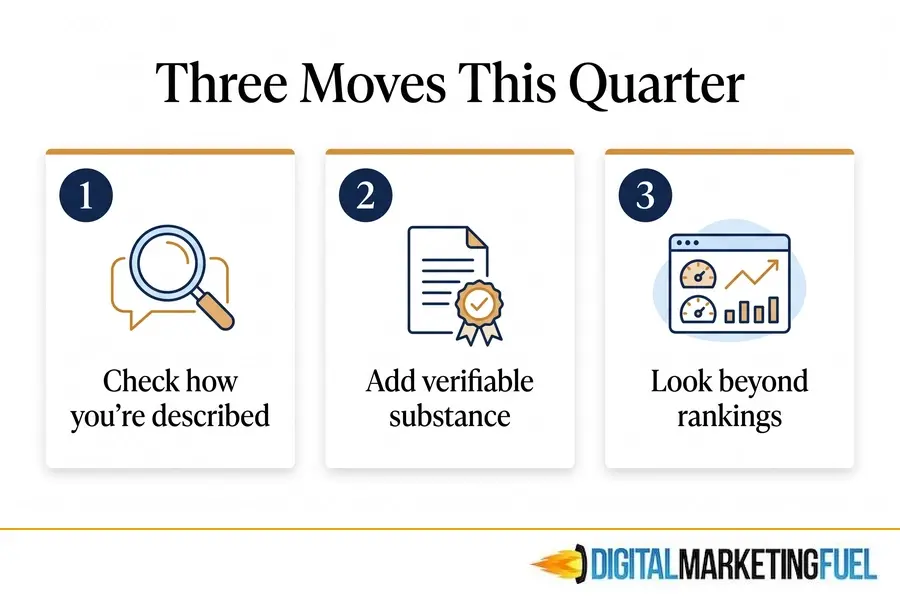
Three moves worth funding this quarter
Skip the rebrand of your marketing plan. Do these instead.
- Check how you’re described, not just whether you appear. Run your brand and your top three competitors through a few assistants. Wrong service list, dead location, or outdated pricing is the damage worth finding.
- Give your best pages verifiable substance. Pick the five pages tied to revenue. Add specifics a machine can quote and a buyer can check.
- Stop scoring yourself on rank alone. Track branded search volume, direct traffic, and what prospects say they read before calling. Mentions without clicks still move demand, but a citation isn’t a sale.
None of that needs a new platform. Most of it needs an afternoon and someone willing to be honest about the current state of your site.
SEO versus GEO
Google’s own documentation says the foundations haven’t changed for AI Overviews and AI Mode. Pages need to be crawled, indexed, and eligible for a normal snippet. There’s no secret markup or hidden switch.
When someone pitches you generative engine work as a replacement for technical hygiene, they’re selling the frame rather than the substance. Broadening your view to include how brands get described in generated answers is fair and useful. Selling it as the thing that killed everything else is not.
Search got messier and harder to measure. That’s the honest version of the story, and it’s the one worth planning around.
Read the full breakdown in AI search hasn’t replaced search engines, which walks through the YouGov data in more depth than I’ve covered here.
FAQ
Should I stop investing in SEO?
No. Search engines remained the leading starting point for every task the survey measured, including purchases. Cutting the channel that still feeds most discovery would be an unusual response to a survey showing exactly that.
Do I need a separate GEO or AEO strategy?
Not a separate one. Add the questions to your existing plan: how does an assistant describe us, what sources does it pull from, and are those sources accurate. Same team, same budget line.
Does an AI mention drive traffic?
Sometimes. Around 22% of AI users said they usually click the supplied links, and 24% said they typically stop searching after the answer. Treat mentions as awareness, not as a replacement for a conversion path.
Summary
Buyers added a tool. They didn’t throw out the old ones. Your job hasn’t shifted so much as widened: be findable, be specific, and be accurate wherever your name comes up.
My advice to every owner asking about this right now is the least dramatic option available. Fix the pages that sell, check what the assistants say about you, and ignore anyone charging a premium to create panic.
Want to know how AI assistants currently describe your business? Request an AI search audit and I’ll show you what they’re saying and where the description comes from.